


Fukuyama-goto (Japanese harp)[Traditional Crafts designated by the Minister of Economy, Trade and Industry]Fukuyama Japanese Instruments Manufacturing Cooperative

| Exhibitor (Manufacturer) | Fukuyama Japanese Instruments Manufacturing Cooperative |
|---|---|
| Address | In Industry division The Fukuyama Chamber of Commerce and Industry 2-10-1 Nishimachi, Fukuyama City, Hiroshima |
| TEL | (084)921-2349 |
| Established | June, 1982 |
| Job description | Manufacture and assembly of Japanese musical instruments |
Fukuyama City is renowned as one of Japan’s leading producers of Koto (Japanese zithers). Its history dates back to 1619, when Mizuno Katsunari, a cousin of Tokugawa Ieyasu, built Fukuyama Castle. In the early 19th century (the Bunka era), Kuzuhara Koto, a master musician who had studied Sokyoku (Koto music) in Kyoto, returned to his hometown and became active in the Bingo and Bitchu regions. It is said that his influence helped establish a strong foundation for Koto production in the Fukuyama area from an early stage.
“Fukuyama Koto”: A Nationally Designated Traditional Craft
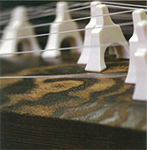
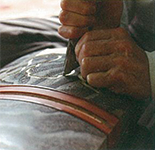
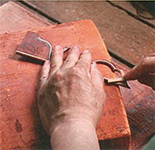
The production process begins with selecting the finest Paulownia (Kiri) wood. It takes about a year just to dry the timber. The process then moves through splitting, carving, scorching, and polishing the body. This is followed by decorative stages including ornamentation and Makie (gold/silver lacquer work), and finally, the attachment of metal fittings and tuning.
Fukuyama Koto is characterized by the exquisite craftsmanship of skilled artisans, visible in every detail—from the use of top-grade dried Paulownia to the intricate handiwork. Its superior tone, beautiful grain, and elegant decorations are the reasons why Fukuyama Koto is celebrated as a premier brand of high-quality Koto.
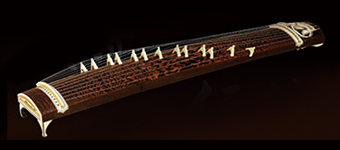
Fukuyama-goto
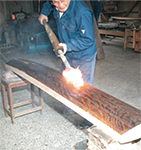
“Burning work” by Harp Master